The Real Estate Investor's Magazine
When Big Repairs Hit: Smart Ways Homeowners Can Pay Without Panic
By Gwen Payne
Homeowners face a familiar problem: roofs fail, HVAC systems quit, and foundations crack at the worst possible time. The solution is less about finding a single perfect payment method and more about combining preparation with flexible financing choices. The result, when done well, is a repair plan that protects both your home and your long-term finances.
article continues after advertisement
Key Takeaways
- Emergency savings reduce stress and borrowing costs when repairs appear.
- Financing options vary widely in speed, risk, and total expense.
- Refinancing can bundle repair costs into predictable monthly payments.
- Comparing options side by side helps avoid rushed decisions.
- Preparation before a crisis expands your choices.
Preparing Before Repairs Become Urgent
Preparation starts long before the contractor’s estimate lands in your inbox. Homeowners who plan ahead tend to borrow less and pay lower interest overall. One practical step is to set aside a dedicated repair fund based on your home’s age and major systems. Another is to periodically review your credit profile, since stronger credit unlocks better terms across nearly every option.
A quick reality check also helps: know which systems are nearing the end of their lifespan and what replacement might cost. That awareness turns a surprise into a scheduled expense.
Payment Options Homeowners Commonly Use
The way you pay often depends on urgency, equity, and cash flow. Each method carries trade-offs.
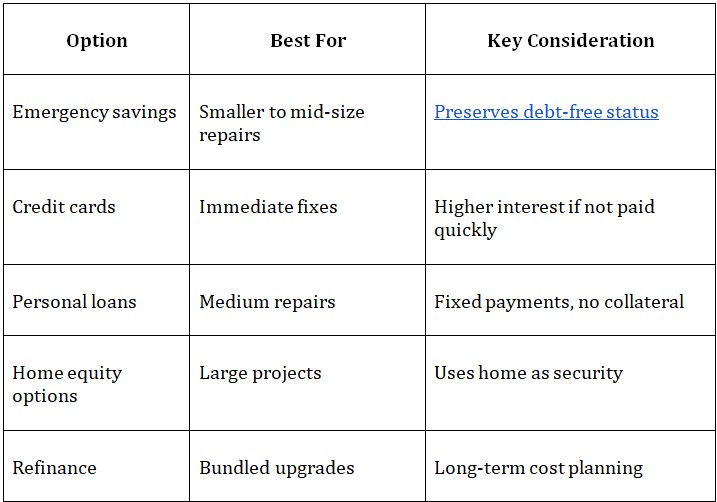
Looking at options together clarifies which path fits your situation rather than defaulting to the fastest approval.
How to Choose a Payment Option When Time Is Tight
When a major repair can’t wait, use this step-by-step approach to narrow choices and avoid costly mistakes.
- Confirm the scope and urgency with at least one written estimate.
- Check available cash and insurance coverage first.
- Review credit and equity to see which financing doors are open.
- Compare total costs, not just monthly payments.
- Choose the option that balances speed with long-term affordability.
This sequence keeps emotions from driving decisions when time is tight.
Using an FHA Refinance to Fund Repairs

An FHA refinance can be a useful tool for homeowners who want to roll repair costs into a new mortgage backed by the Federal Housing Administration. The benefits of the FHA cash out plan include gaining access to more forgiving credit standards and steadier monthly payments. Most FHA-backed mortgages require mortgage insurance premiums paid upfront and continuing for the life of the loan, which should be factored into the total cost. Eligibility typically includes a seasoning period, meaning you usually need at least six monthly payments completed on your current mortgage before refinancing.
article continues after advertisement
Repair Financing Questions Homeowners Ask
Before committing to a payment method, homeowners often need clarity on the final details.
Should I finance repairs or wait and save?
Financing makes sense when a repair affects safety or prevents further damage. Waiting can increase total costs if problems worsen. The decision often hinges on urgency and the interest rate you can secure.
How much emergency savings is realistic?
Many homeowners aim for one to three percent of their home’s value annually. Older homes may need more frequent contributions. The goal is progress, not perfection.
Does using home equity put my house at risk?
Yes, equity-based options use your home as collateral. That risk is manageable when payments fit comfortably within your budget. Overextending is the real danger.
Are credit cards ever a smart choice?

They can work for short-term gaps or rewards if paid off quickly. Carrying balances long term usually costs more than other financing. Discipline is essential.
How long does refinancing usually take?
Refinancing often takes several weeks from application to closing. It’s better suited to planned or semi-urgent repairs. Immediate emergencies may need interim solutions.
Will financing repairs hurt resale value?
Well-documented repairs that improve safety or efficiency often help value. Poorly planned projects can have the opposite effect. Keeping records protects you later.
Closing Thoughts
Major home repairs test both patience and planning. By preparing early, understanding your payment options, and choosing deliberately, you turn a stressful moment into a manageable project. The right strategy protects your home today while keeping your finances steady tomorrow.
Gwen Payne
Gwen Payne is a stay-at-home mom with an entrepreneurial spirit. Over the years, she has mastered raising her two daughters while side hustling to success through small ventures based on her passions - from dog walking to writing to E- commerce. With Invisiblemoms.com, she hopes to show other stay-at-home parents how they can achieve their business-owning dreams.
Comment
INTERACT AND NETWORK
We encourage you to add photos, blog posts, event invitations and videos to your page! To reach a LIVE person, please email our office at: info@realty411.com
About
Realty411was created in 2007 to serve active real estate investors. Be sure to join our networking site and connect with our VIP readers.
Birthdays
RSS
Groups
Events
Forum
Have You Lost Money with a "Guru"? If So, What Did You Do?
Started by Realty411 Magazine in Sample Title Mar 17. 0 Replies 0 Likes
© 2026 Created by Realty411 Magazine.
Powered by


You need to be a member of REALTY411 to add comments!
Join REALTY411